
If your artificial turf smells worse in August than it does in February, the turf is not the problem.
Odor does not live on the blades. It lives down in the infill and at the backing, where urine solids, organic debris, and bacteria collect over months of use. That is why rinsing with a hose, running a sprinkler over it, or spraying a foaming deodorizer never quite works — those approaches move the problem around, or push it deeper.
As Washington’s leader in synthetic turf installation, supply, and maintenance, we have spent years telling homeowners and property managers the same honest thing: synthetic turf is low maintenance, not no maintenance. Odor is the clearest example of that.
So we built a service for it. Pure Turf Cleaning is a new hydrogen-peroxide-based deep clean inside the STNW Care Program — and the important part is what happens at the end of the visit, not the beginning.
Why Turf Starts to Smell — And Why Rinsing Doesn’t Fix It
The Pacific Northwest creates a specific set of conditions for odor:
- Heavy pet traffic concentrated into the same small area, year after year
- High organic debris from trees, bark, and surrounding landscaping
- Long wet seasons that keep organic matter damp and breaking down
- Covered patios, rooftop decks, and awnings that never get a natural rain flush
- Infill that compacts over time and slows drainage
Once contaminants settle below the fiber line, surface treatments cannot reach them. A hose puts clean water in and leaves everything else behind. A foaming product masks the smell for a few days. Pressure washing alone can relocate the contamination and disturb the infill without removing anything.
The fix has to do two things: break down what is down there, then physically remove it from the property.
What Pure Turf Cleaning Actually Is
Our hydrogen-peroxide-based cleaning solution helps eliminate bacteria, viruses and odor-causing contaminants from artificial turf.
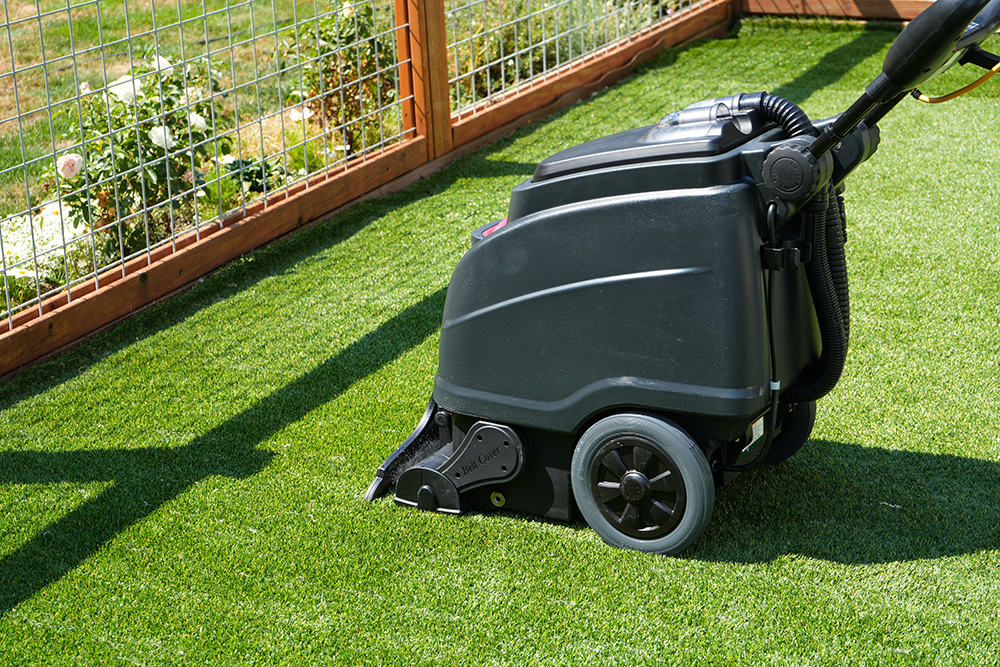
The solution is applied under pressure so it carries down through the fibers and into the infill, given time to work, and then pulled back out with a commercial extractor. Extraction is the whole point. It is the difference between treating turf and rinsing turf.
A few things worth knowing:
- No masking fragrance. Hydrogen peroxide breaks down into water and oxygen. We are not covering the smell with a scent.
- Kids and dogs are back on it in about one to two hours. This is not a service that takes your yard out of commission for a weekend.
- It works on a schedule. High-traffic dog areas are usually better served by a recurring plan than a single visit.
- It is a documented process. We can hand your facilities team the safety data sheet and our written step-by-step procedure for your vendor file.
What Happens During a Visit
1. Prep and Debris Removal
We brush the turf to lift matted fibers and stand the blades back up, then leaf blow the entire area. Cleaning solution poured onto a bed of organic debris does not reach anything.
2. Application Under Pressure
The solution is mixed and applied with a pressure washer and X-Jet in a fanning pattern so coverage is even across the whole surface rather than concentrated in the worst corner. We plan roughly 1.5 gallons of solution per 500 square feet.
3. Dwell Time
The solution sits for five to ten minutes. This is the step most DIY attempts skip, and it is the step that does the work.
4. Extraction
A commercial extractor flushes and pulls the solution and the suspended contaminants back out of the turf system. Our crews work backward across the area so nothing gets walked back in, and they run a second extraction pass on the worst zones — usually the dog-relief corner or the shaded section under a cover.
5. Light Rinse and Reset
A very light water rinse finishes the surface, equipment and surroundings get cleaned down, and we let you know when the area is ready for use again — typically one to two hours.
Where This Service Matters Most
Dog Parks, Kennels, Daycares, and Pet-Relief Areas
When the same 400 square feet gets used a hundred times a day, no amount of rinsing keeps up. This is the highest-value application we have, and it is almost always a recurring plan rather than a one-time clean.
Rooftop Decks, Amenity Lawns, and Multifamily Common Areas
Rooftop and amenity turf takes a specific kind of beating: full sun, dog traffic concentrated in one corner, and no rain flush under the covered sections. Residents notice odor before they notice anything else about the deck, and property managers hear about it directly.
Schools, Childcare Centers, Playfields, and Campus Turf
Institutional turf carries a documentation requirement as much as a cleaning requirement. We supply the safety data sheet and written process so the service lands cleanly in your maintenance records.
Residential Lawns and Pet Areas
For homes, Pure Turf Cleaning pairs with a standard Care Program clean rather than replacing it — the deep clean handles odor, the standard visit handles debris, fiber grooming, and preventative treatments.
Indoor Turf
Home gyms, golf simulators, showrooms, and event spaces all accumulate odor without ever seeing weather. Indoor work is scoped individually because layout and drainage access vary widely.
Transparent Pricing, Built for Flexibility
Odor Cleaning is priced by area as a one-time service:
- Up to 500 sq ft — $150
- 501–1,000 sq ft — $300
- 1,001–1,500 sq ft — $450
- 1,501–2,000 sq ft — $600
- 2,001–2,500 sq ft — $750
Anything above 2,500 square feet is quoted individually, as are commercial and rooftop projects where access and water supply change the scope.
Combo service — odor cleaning bundled with a full CareProgram clean — runs from $650 depending on area. And as with the rest of the CareProgram, recurring plans lower your per-visit cost: bi-annual, tri-annual, and quarterly options are available, with quarterly delivering the best per-visit value. High-traffic dog areas almost always end up on quarterly.
The CareProgram is built as a subscription that auto-renews, so seasonal service does not get
Documentation for Facilities and Property Teams
If you manage turf on behalf of an owner, a board, a district, or a tenant population, “we sprayed something” is not a maintenance program. On request we provide:
- The manufacturer’s safety data sheet for the cleaning solution
- Our written step-by-step service procedure
- Re-entry guidance you can post or distribute to residents and staff
- Coverage and scheduling documentation for your vendor file
Send those to us in a work order and we will return them the same day.
Thought Leadership Means Setting the Standard
Synthetic turf continues to prove itself as one of the smartest landscape investments for Puget Sound property owners. As Washington’s leading synthetic turf supplier and installer — with full-service teams based in Woodinville and Fife — we believe our responsibility extends beyond installation.
Odor is the complaint people are most likely to live with rather than solve, because most of the available answers do not work. Building a real process for it, documenting it, and pricing it openly is part of how this industry earns long-term trust.
Ready to Protect Your Investment?
We are holding priority September scheduling for CareProgram contacts and commercial properties before fall install season loads up our crews. There is no charge for an assessment — we look at the area, measure it, and tell you what it needs.
Have questions or ready to get started?
Call or email us today to learn more about Pure Turf Cleaning and the CareProgram, and to receive a personalized quote.
425-689-7058 or care@syntheticturfnw.com